Moving Mountains for Conservation - The Arkansas Approach to Restoring Connectivity
Tim Burnley
Stream Habitat Supervisor
Arkansas Game and Fish Commission
Mountain Home, AR
Arkansas is blessed with 137,224 miles of streams that vary from the Ozark Highlands to the Mississippi River Valley. The Arkansas Game and Fish Commission's Stream Habitat Program is comprised of five Stream Habitat Coordinators who work with landowners and other partners to restore streams through bank stabilization and barrier removal statewide. Their efforts focus primarily on the aquatic Conservation Opportunity Areas (COAs) as defined by the Arkansas Wildlife Action Plan and they work hand in hand with our taxa leads to ensure that projects are beneficial to SGCNs and federally listed species. The program is an active participant in the state's Aquatic Connectivity Team, the Arkansas Stream Heritage Partnership (ASHP), and are trained to assess and prioritize AOP barriers using the SARP protocol. Currently, through the actions of the program's coordinators and contractors we are nearing completion of assessment and prioritization of all barriers on 2nd order and above streams in our aquatic COAs and have used this information to acquire federal grant funds to perform landscape level conservation projects including an America the Beautiful Challenge grant on War Eagle Creek and a National Fish Passage Program grant on Robinson Creek. We rely heavily on partners to complete these important projects and collectively look for innovative ways to put projects on the ground. Another unique aspect of our work is the use of agency manpower and equipment to remove barriers, haul materials, and build structures which allows us to complete small projects in-house and make match for large federally funded projects. Through the opportunities provided by our strong in-state partnerships, and the capacity and willingness to utilize agency resources, meaningful changes that will benefit Arkansans well into the future are happening.
About Tim Burnley
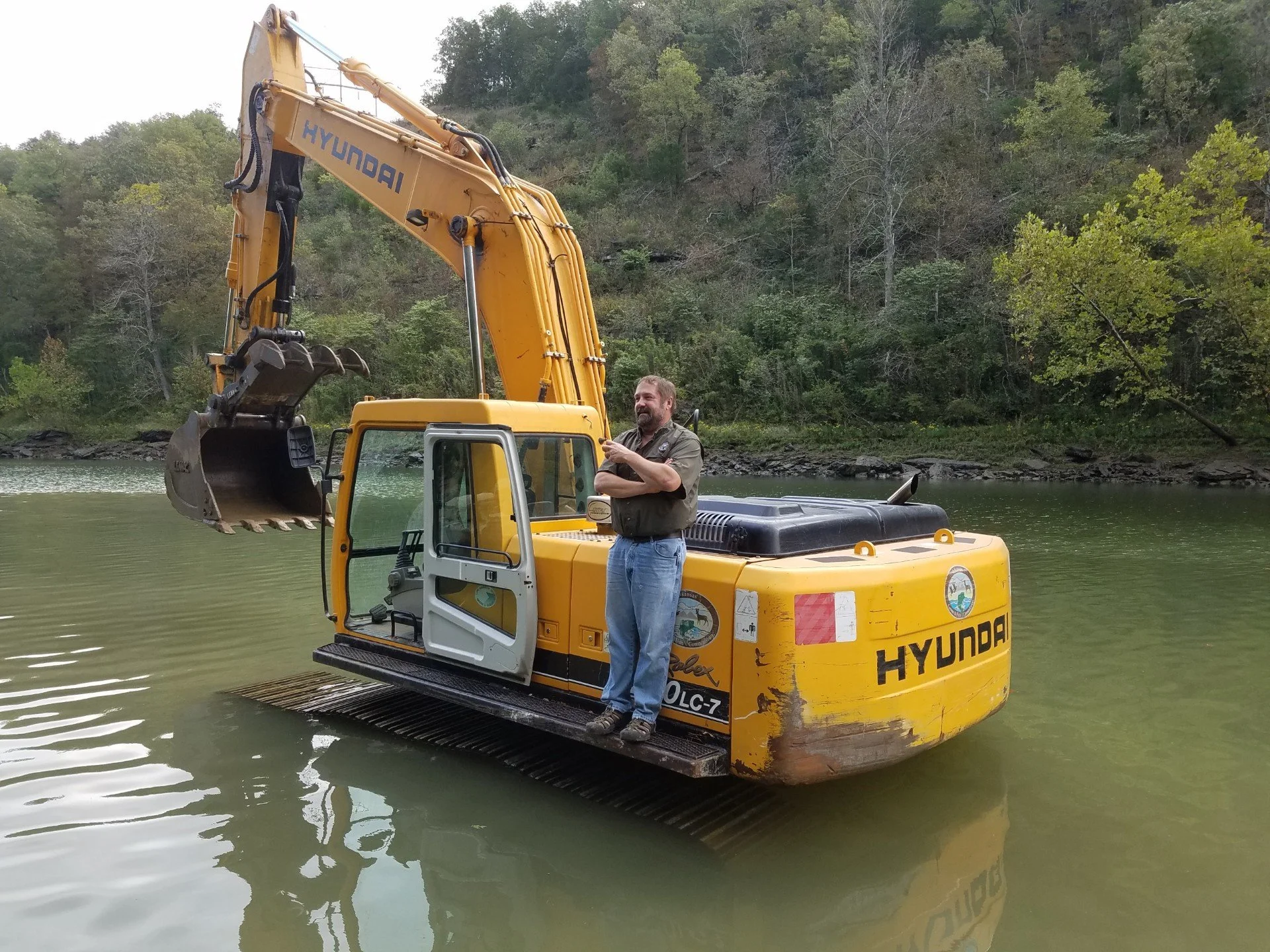
Tim Burnley is currently the Stream Habitat Supervisor for the Arkansas Game and Fish Commission. This position has statewide responsibility on the 90,000+ miles of streams, both cold and warm water, in the state. Additionally, Tim works on many other projects that benefit the sportsman of Arkansas. He received his B.S. in Biology from Harding in 1992 and his M.S. in Zoology from the University of Arkansas in Fayetteville in 2004. He started his career with the Arkansas Game and Fish Commission in August of 1995 as a part-time employee for Fisheries District II. In January 1996, he became the Assistant District Biologist in East Central Arkansas where he worked until May of 2004 when he moved to Mountain Home to become the Program Technician for the Trout Habitat Program. While in East Central Arkansas he helped manage the lakes and rivers of that area, and was instrumental in developing regulations and reporting requirements for the commercial harvest of mussels and paddlefish. In July 2007, he became a biologist for the program and was promoted to Trout Habitat Manager in July 2008. In October 2018, the Stream Team program and its four coordinators were put under Tim, adding the warm water streams of the state to his responsibilities. Tim has been a Certified Fisheries Professional recognized by the American Fisheries Society since 1999.