Wilburn Creek Stream Bank Stabilization and Restoration
Megan Brandt
Arkansas Game and Fish Commission
Mountain Home, AR
Authors: Brandt, M. Burnley, Tim.
Lotic waterways provide vital aquatic habitat, food, water, and flood protection, but in tailwater systems such as the Greers Ferry tailwater, they are also influenced by hydroelectric power generation. These tailwater systems have increased the frequency of unnatural hydrologic patterns, intensifying the natural processes of river widening and the development of steeper streambed slopes, thereby increasing stress on the main-stem stream banks and tributary stream banks. In some sections, the banks of tributaries also experience accelerated erosion from main-stem fluctuations or increased velocities during flood events, when the main stem is low. The nonpoint source sediment and nutrient loads entering the Little Red River increase with accelerated erosion, making it vital to prioritize and restore at-risk stream banks. Using the Bank Erosion Hazard Index (BEHI) and Near Bank Stress (NBS) factors, a survey of several tributaries of the Little Red River determined that the over 1,000 feet section of impaired bank along Wilburn Creek is one of the highest contributing sections for nonpoint source sediment pollution. The Coldwater Habitat Program plans to construct bank stabilization structures to stabilize the impaired banks along Wilburn Creek to reduce nonpoint source sediment and nutrient loads flowing into the Little Red River watershed (a priority watershed). With the construction of natural channel design structures, the restoration goals are to decrease erosion and nonpoint source pollution, reestablish a floodplain bench, and to restore a healthy native riparian buffer.
About Megan Brandt
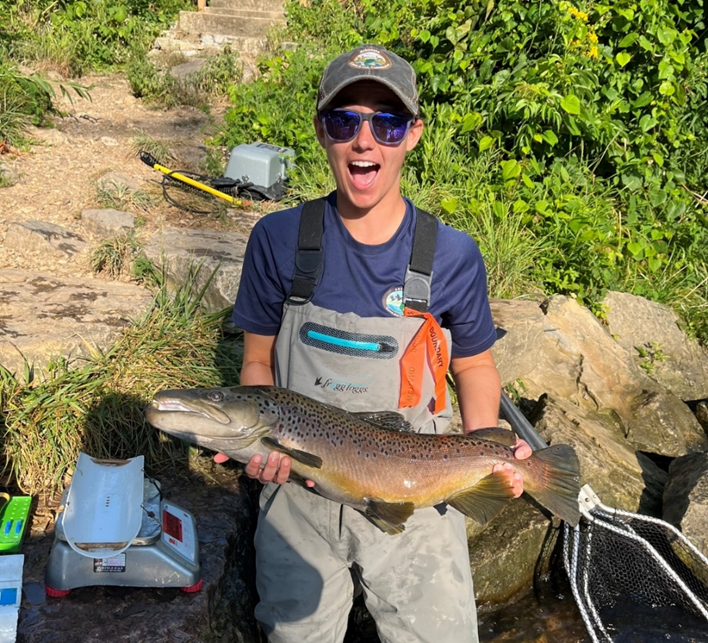
Megan Brandt is the Coldwater Habitat Coordinator for the Arkansas Game and Fish Commission and leads stream restoration and bank stabilization efforts for the state's coldwater systems. Her program focuses on stream assessments, development of restoration plans, construction of bank stabilization structures, in-stream habitat installation, and riparian vegetation reestablishment. She also coordinates a program that provides bank stabilization assistance to private landowners along the trout waters and their tributaries.
Megan received her BS from Hanover College in Environmental Biology and her MS from Murray State University in Biology. Prior to joining the Arkansas Game and Fish Commission, she held multiple research positions and was involved in projects ranging from eDNA detection/monitoring, aquatic habitat adjustments, and native vegetation biodiversity.